
Santa Rosa County Court Records After a Jail Arrest
After an arrest in Santa Rosa County, a person is booked into the county jail and the charges from the arrest appear on the roster. The court record begins later, when the prosecutor reviews the case and files a charging document. From that point the case has a court case number, and the court record, not the booking entry, becomes the authoritative source for what the state is pursuing. The prosecutor here is the Office of State Attorney for the First Judicial Circuit.
It helps to keep the two sides apart. The arrest and booking detail, including the mugshot and the bond at intake, sit with the Sheriff and show up on the jail inmate records roster, with booking photos on the jail roster mugshots page. The court record, by contrast, tracks the filed charges, hearings, and disposition through the clerk's system. Both grow out of the same arrest, but they answer different questions.
How to Find Santa Rosa County Court Records After an Arrest
Court records run through the Santa Rosa County Clerk of Court and Comptroller, currently Jason D. English. The clerk offers an online case search, and the statewide Civitek Online Court Records Search portal serves Santa Rosa County records. Public access is anonymous; attorney, registered-user, and party access require a login.
The county's Civitek court records access page shows the four access options for Santa Rosa County.
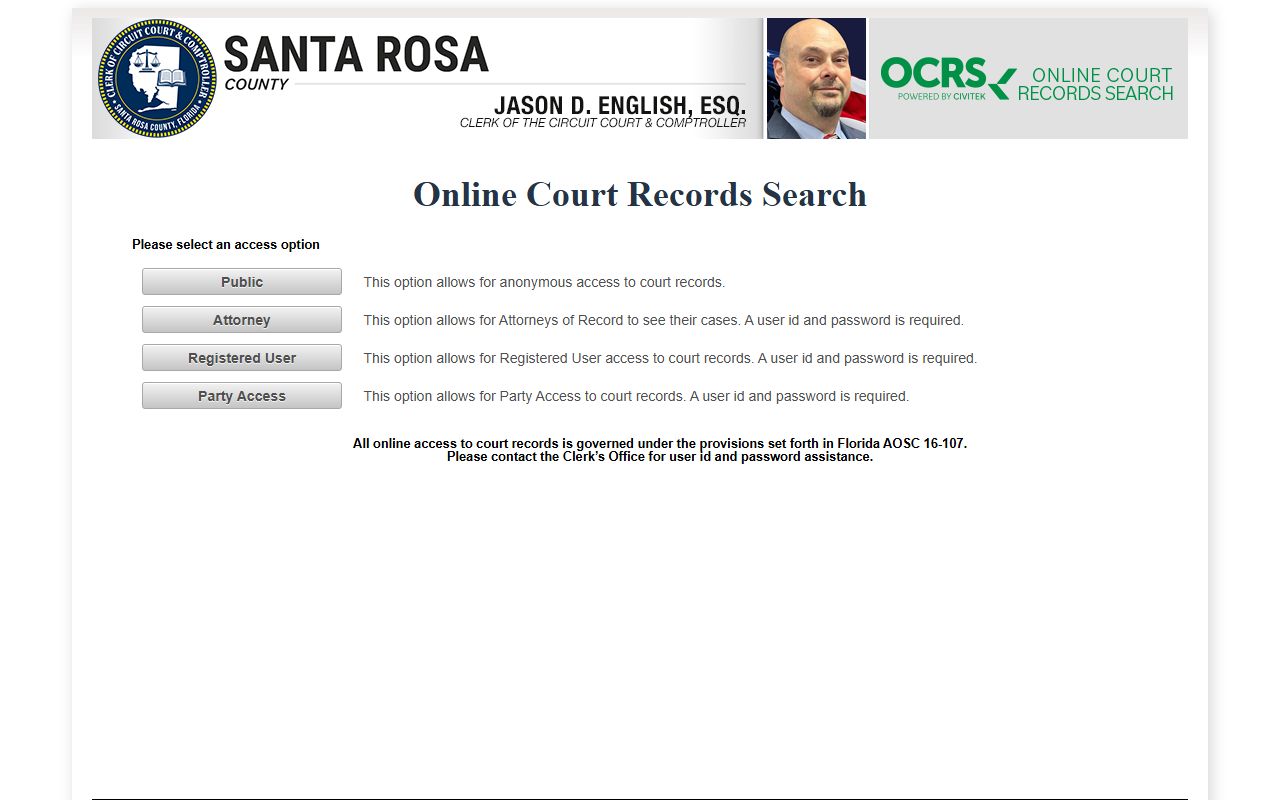
From that page the public button opens anonymous access, which is the route most people use to read a case after an arrest.
- Open the clerk's public records search or the Civitek portal for Santa Rosa County.
- Choose public access and search by defendant name or case number.
- Open the case and read the list of filed charges.
- Check each charge's statute, level, and current status.
| Access Type | Login | Who It Is For |
|---|---|---|
| Public | None | Anonymous access to court records |
| Attorney | Required | Attorneys of record on their cases |
| Registered User | Required | Approved registered users |
| Party Access | Required | Parties to a case |
All online access runs under Florida AOSC 16-107, which sets what each type of user can see. Statewide criminal history is held by the Florida Department of Law Enforcement, a separate fee-based search worth knowing about if a county case index is not enough.
How Charges Get Filed After an Arrest: Complaint, Information, and Indictment
The arrest does not set the final charges. After booking, the charge record begins when the prosecutor files a charging document, and the type depends on the case. A complaint is common for lower-level matters, an information is the usual route for many felonies, and an indictment from a grand jury is reserved for the most serious felonies. Filed charges can differ from the charges listed at booking.
| Complaint | Information | Indictment | |
|---|---|---|---|
| Filed By | Officer / Prosecutor | Prosecutor | Grand Jury |
| Common For | Misdemeanors | Many felonies | Serious felonies |
| Starts | The case | The case | The case |
Charge Status in the Court Record
Charges shift as a case moves. A count can be amended, reduced, added, dropped, or dismissed, and the court record tracks each change. This is why a booking charge on the roster can read differently from what the prosecutor finally files. A few status terms come up often. Nolle prosequi means the prosecutor chose not to proceed on a charge, while a dismissal ends a charge without a conviction.
| Status | What It Means |
|---|---|
| Pending | The charge is filed and the case is still moving through court. |
| Amended / Reduced | The charge was changed or lowered from what was first filed. |
| Dismissed | The charge ended without a conviction. |
| Nolle Prosequi | The prosecutor declined to pursue the charge. |
Bond and Release After an Arrest
Bond is often set at a first appearance, an early hearing after the arrest, or it can come from a warrant. On the roster, bond shows per charge and at the record level, but a total dollar amount does not guarantee release. Holds, no-bond charges, warrants from another county, federal custody under the Marshals contract, or an immigration matter can keep someone in jail even when local bond looks payable.
| Bond Type | How It Works |
|---|---|
| Cash Bond | The full amount is paid through the authorized channel. |
| Surety Bond | A licensed bail agent posts the bond for a fee. |
| PR / Own Recognizance | Release on a promise to appear, without paying full cash. |
| No-Bond Hold | No bond is set, or a hold blocks release pending a court order. |
The Sheriff's Office did not publish a bond-payment page, so confirm accepted methods by calling the jail at (850) 983-1120. A bond order can also be modified by the court as a case develops, which is one more reason the court record, not the booking entry, is the place to confirm the current bond and any conditions.
Warrants That Lead to an Arrest
Many bookings begin with a warrant. An arrest warrant authorizes police to take someone into custody, while a bench warrant is issued by a judge, often for a missed court date. No standalone public warrant search was found for Santa Rosa County, so the practical checks are the jail roster for anyone already booked and the clerk's court records for a case showing a bench warrant or a failure-to-appear entry. For custody questions, call the non-emergency line at (850) 983-1190 or the jail line, and for documents use SRSO Records at (850) 983-1268 or the JustFOIA portal.
The First Judicial Circuit State Attorney
Charges in a Santa Rosa County case are filed by the Office of State Attorney for the First Judicial Circuit, led by State Attorney Ginger Bowden Madden. The circuit serves four counties, Escambia, Santa Rosa, Okaloosa, and Walton, and keeps a local office in Milton. The prosecutor, not the arresting officer, decides which charges go forward, which is why the court record can read differently from the arrest.
The clerk is the office that keeps and publishes the case file. The Santa Rosa County Clerk of Court and Comptroller, currently Jason D. English, runs the public case search and handles records requests at the courthouse in Milton. Between the prosecutor who files and the clerk who records, the court file becomes the reliable account of what happened after an arrest.
Case Number vs. Booking Number
Two numbers get confused all the time. A booking number is the jail's identifier for an intake and lives on the roster. A court case number is the clerk's identifier for a filed case and lives in the court record. A recent booking may even show "NA" in the court case number field, with the arresting agency named instead, because the case has not been filed yet. Once the prosecutor files, the case number is what you use to follow charges, hearings, and the final disposition through the clerk's system.
Charges vs. Convictions After an Arrest
Being arrested and charged is not the same as being convicted. A charge is an accusation; a conviction follows a plea or a verdict. The roster and the early court record both show charges, which is why neither one proves guilt.
| Charge | Conviction | |
|---|---|---|
| Stage | Accusation | Verdict or plea |
| Burden of Proof | Probable cause | Beyond reasonable doubt |
| Public Record | Yes | Yes |
Sealed vs. Expunged Court Records After an Arrest
Florida lets some people clear an arrest record after a dismissal or an eligible outcome. Court-ordered expunction runs under Fla. Stat. 943.0585. Sealing hides a record from public view while leaving limited access for certain agencies; expunction goes further and treats the record as though it never existed. Eligibility is set by state law and turns on the charge and the outcome.
| Sealed | Expunged | |
|---|---|---|
| Visibility | Hidden from public | Destroyed / treated as never existed |
| Law Enforcement | Limited access | Very limited |
| Eligibility | Set by Florida statute and the disposition | Set by Fla. Stat. 943.0585 and the disposition |
Background Check Considerations
A casual court-records lookup is not the same as a regulated background check. Formal screening for jobs or housing must follow the federal Fair Credit Reporting Act and use a proper consumer reporting agency.
Important: This site is not a consumer reporting agency under the FCRA, and its information may not be used for employment, housing, credit, or insurance screening.
Restricted Court Records After an Arrest in Santa Rosa County
Not every court record after an arrest is open. Florida's public-records law carries exemptions, and Fla. Stat. 119.071 covers criminal-justice and privacy exemptions that can shield parts of a record. Juvenile cases, sealed or expunged charges, victim information, and active investigations are commonly restricted or redacted. When the clerk's index is thin, the clerk's public-records channel at PublicRecordRequest@santarosaclerk.com is the formal route, and exemptions may still apply.
For an in-person trip, the courthouse is at 4025 Avalon Boulevard in Milton, and the clerk's main line is (850) 981-5554. The State Attorney's Milton office sits at 6495 Caroline Street. Keep in mind that online access through the Civitek portal runs under Florida AOSC 16-107, which limits what anonymous public users can see compared with attorneys or parties on a case. When the public view stops short, a records request to the clerk is the way to ask for the rest, subject to the exemptions above.